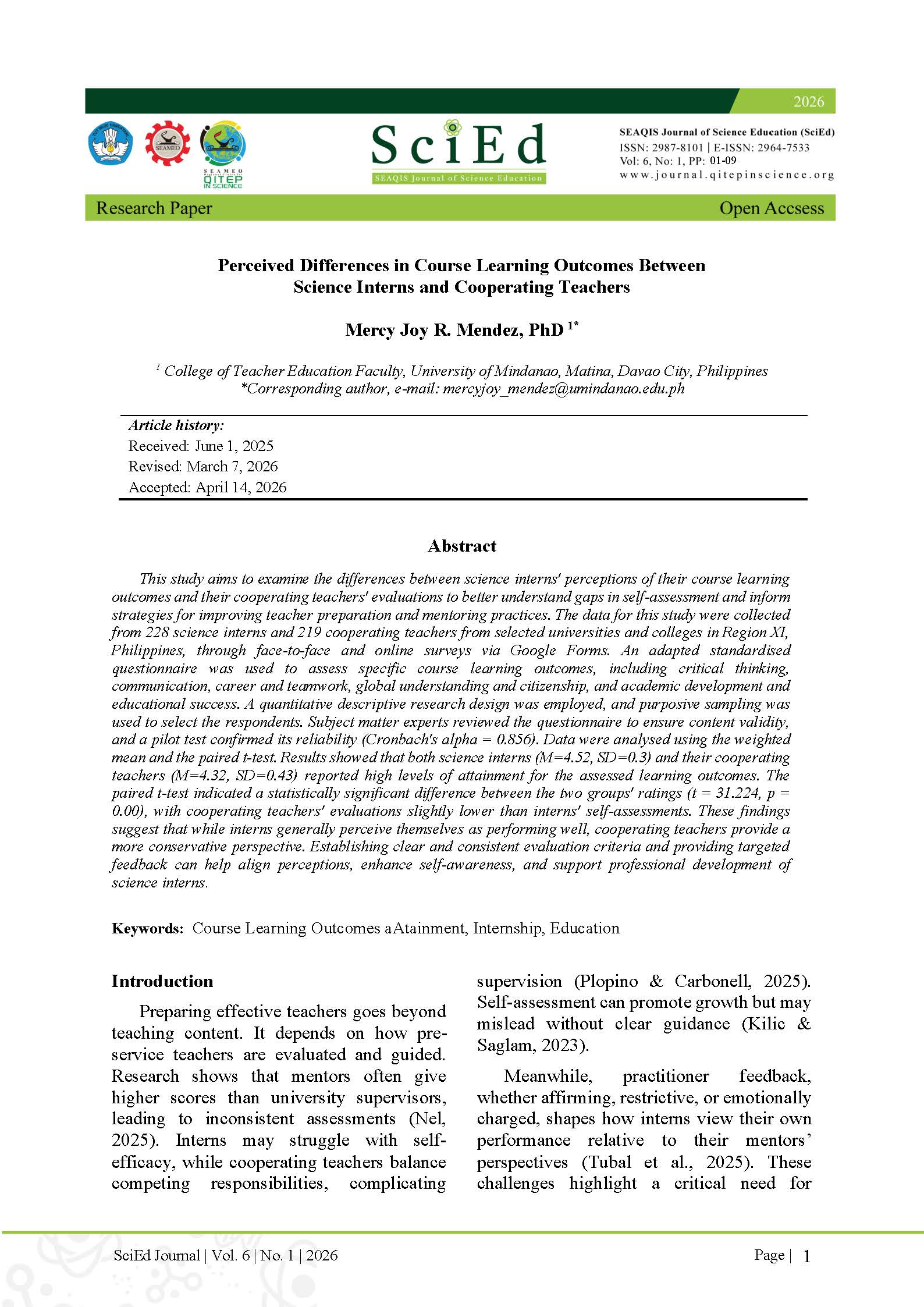
Perceived Differences in Course Learning Outcomes Between Science Interns and Cooperating Teachers
DOI:
https://doi.org/10.58249/sjse.v6i01.203Keywords:
course learning outcomes attainment, internship, educationAbstract
This study aims to examine the differences between science interns' perceptions of their course learning outcomes and their cooperating teachers' evaluations to better understand gaps in self-assessment and inform strategies for improving teacher preparation and mentoring practices. The data for this study were collected from 228 science interns and 219 cooperating teachers from selected universities and colleges in Region XI, Philippines, through face-to-face and online surveys via Google Forms. An adapted standardised questionnaire was used to assess specific course learning outcomes, including critical thinking, communication, career and teamwork, global understanding and citizenship, and academic development and educational success. A quantitative descriptive research design was employed, and purposive sampling was used to select the respondents. Subject matter experts reviewed the questionnaire to ensure content validity, and a pilot test confirmed its reliability (Cronbach's alpha = 0.856). Data were analysed using the weighted mean and the paired t-test. Results showed that both science interns (M=4.52, SD=0.3) and their cooperating teachers (M=4.32, SD=0.43) reported high levels of attainment for the assessed learning outcomes. The paired t-test indicated a statistically significant difference between the two groups' ratings (t = 31.224, p = 0.00), with cooperating teachers' evaluations slightly lower than interns' self-assessments. These findings suggest that while interns generally perceive themselves as performing well, cooperating teachers provide a more conservative perspective. Establishing clear and consistent evaluation criteria and providing targeted feedback can help align perceptions, enhance self-awareness, and support professional development of science interns.
References
Andayani, M. S., Divayana, D. G., & Suyasa, P. W. (2023). The influence of interest in being a teacher on learning outcomes in microteaching in semester VI students of the education program technical information. In Proceedings of the 5th International Conference on Vocational Education and Technology (IConVET 2022), 6 October 2022, Singaraja, Bali, Indonesia.
Arif, A., Rahman, F., Zainurrahman, M., & Arieffandy, A. (2022). Correlation between interest in becoming a teacher and educational subject learning outcomes for automotive engineering education students. Automotive Engineering and Vocational Education Journal (AEEJ), 3(2), 57–63. https://doi.org/10.24036/aeej.v3i2.169
Astin A. W. (1993). What matters in college? Four critical years revisited. San Francisco, CA: Jossey-Bass.
Blakeman, R., & Taylor, M. (2019). Team creative brief: creative and account teams speak out on best practices. Journal of Advertising Education, 23(1), 39-52. https://doi.org/10.1177/1098048218812132
Bernardo, A.B., Cordel, M.O., Ricardo, J.G., Galanza, M.A., & Almonte-Acosta, S.A. (2022). Global Citizenship Competencies of Filipino Students: Using Machine Learning to Explore the Structure of Cognitive, Affective, and Behavioral Competencies in the 2019 Southeast Asia Primary Learning Metrics. Education
Boholano, H. B., Jamon, B. E. V., Merin, J. A., Polinar, D. D. G., Corales, E. F., Argate, R. T., Chua, L. I., Barredo, B. S., Palma, R. C., & Cajes, R. C. (2021). Field Study 1. Mutya Publishing House Inc.
Creswell, J. W. (2014). Research design: Qualitative, quantitative, and mixed methods approaches. Sage Publications.
Dela Fuente, J. A. (2021). Contributing factors to the performance of pre-service physical science teachers in the Licensure Examination for Teachers (LET) in the Philippines. Journal of Educational Research in Developing Areas, 2(2), 141–152. https://doi.org/10.47434/JEREDA.2.2.2021.141
Duignan, B. (2024). Dunning-Kruger effect. Encyclopedia Britannica. Retrieved March 8, 2024, from https://www.britannica.com/science/Dunning-Kruger-effect
Farillon, L. M. F. (2022). Scientific reasoning, critical thinking, and academic performance in science of selected Filipino senior high school students. Utamax: Journal of Ultimate Research and Trends in Education, 4(1), 51–63. https://doi.org/10.31849/utamax.v4i1.8284
Floris, M., Paganin, G., Guglielmi, D., & Mazzetti, G. (2024). Motivation is not enough: How career planning and effort regulation predict academic achievement. Current Psychology, 43, 9280–9289. https://doi.org/10.1007/s12144-023-05070-6
Hidayatulloh, M. K. Y., & Ashoumi, H. (2022). The perspective of work readiness in vocational school students with 21st-century communication and collaboration skills. Cypriot Journal of Educational Sciences, 17(7), 2199–2206. https://doi.org/10.18844/cjes.v17i7.7588
Ifechi, A. N., Okoli, I. E., & Nwosu, K. C. (2022). Influence of professional career development and teamwork on employee job satisfaction: Evidence from private universities in Nigeria. Journal La Bisecoman, 3(3), 80–95. https://doi.org/10.37899/journallabisecoman.v3i3.649
Kilic, D., & Saglam, N. (2023). The use of self assessment in improving pre service teachers’ professional development. Science Insights Education Frontiers, 19(2), 3057–3071. https://doi.org/10.15354/sief.23.or436
Lee, C. (2021). Effects of self-efficacy, teamwork, and self-leadership on job satisfaction as mediated by career planning: By year of college of maritime sciences. Journal of the Korean Society of Marine Environment and Safety. Retrieved March 9, 2024, from http://www.kosomes.or.kr/journal/article.php?code=80749
Lewis, W. M. (2021). Employee perceptions of collaborative communication skills learned in the informal workplace. Walden University ScholarWorks. Retrieved March 9, 2024, from https://scholarworks.waldenu.edu/cgi/viewcontent.cgi?article=11865&context=dissertations
Lucas, M. R., & Corpuz, B. (2020). Facilitating learner-centered teaching (5th ed.). Lorimar Publishing Inc.
Magulod, G. C. (2019). Learning styles, study habits and academic performance of Filipino university students in applied science courses: Implications for instruction. Journal of Technology and Science Education. Retrieved March 9, 2024, from https://files.eric.ed.gov/fulltext/EJ1210888.pdf
Mahoney, J.L., Weissberg, R.P., Greenberg, M.T., Dusenbury, L., Jagers, R.J., Niemi, K., Schlinger, M., Schlund, J., Shriver, T.P., VanAusdal, K., & Yoder, N. (2020). Systemic social and emotional learning: Promoting educational success for all preschool to high school students. The American Psychologist, 75(1), 94–105. https://doi.org/10.1037/amp0000455
Nel, B. P. (2025). Mentor and supervisor score differences in evaluating pre service mathematics teachers. Perspectives in Education, 43(4), 327–340. https://doi.org/10.38140/pie.v43i4.9564
Nikolopoulou, K. (2022). What is purposive sampling? Definitions and examples. Scribbr. Retrieved March 4, 2024, from https://www.scribbr.com/methodology/purposive-sampling/
Plopino, M. E. B., & Carbonell, S. S. (2025). Assessment of instructional supervision level of pre service teachers in learning delivery. International Journal of Research and Innovation in Social Science, 9(5), 2554–2579. https://doi.org/10.47772/IJRISS.2025.905000198
Prentice, M., & Robinson, G. (2010). Improving student learning outcomes with service learning. American Association of Community Colleges. Retrieved December 10, 2023 from, https://eric.ed.gov/?id=ED535904
Rosselot-Merritt, J., & Bloch, J. (2020). Mentoring in business and professional communication: Case study of a multiyear dynamic. Business and Professional Communication Quarterly, 83(1), 5-33. https://doi.org/10.1177/2329490619885891
Tubal, F. S. C., Saluta, R. M. B., Cabrido, C. B., & Embang, S. I. (2025). Pre service teachers’ lived experiences with feedback and its role in their professional becoming. International Journal of Learning, Teaching and Educational Research, 24(9), 628–648. https://doi.org/10.26803/ijlter.24
Vijayamohan, P. (2024). Purposive sampling 101: Definitions, types, and examples. SurveySparrow. RetrievedMArch 3, 2024, from https://surveysparrow.com/blog/purposive-sampling/
Wang, Y. L., & Guan, H. F. (2020). Exploring demotivation factors of Chinese learners of English as a foreign language based on positive psychology. Revista Argentina de Clínica Psicológica, 29, 851–861. https://doi.org/10.24205/03276716.2020.116
Zakariya, Y. F. (2022). Cronbach’s alpha in mathematics education research: Its appropriateness, overuse, and alternatives in estimating scale reliability. Frontiers in Psychology, 13, 1074430. https://doi.org/10.3389/fpsyg.2022.1074430
Downloads
Published
Issue
Section
Citation Check
License
Copyright (c) 2026 SEAQIS Journal of Science Education

This work is licensed under a Creative Commons Attribution 4.0 International License.

This work is licensed under a Creative Commons Attribution 4.0 International License.